Forex scalping has a simple promise: take many small trades, each with a small edge, and let the numbers add up. We tested that promise on real broker data, and the result was one of the clearest lessons in our whole research programme. I am Theoneste NZAKIZWANIMANA, founder of TradeLab Research, and this post explains what happened.
We tested Asian-session mean reversion on currency pairs in 12 settings. All 12 made money before costs, between +0.04R and +0.11R per trade. All 12 lost money after costs, between −0.07R and −0.17R per trade. The spread alone cost 0.14R to 0.22R per trade, more than the whole edge.
The ideas were not useless. The prices really did tend to snap back. The problem was that the edge was smaller than the toll paid to enter and exit. This post is about that toll. Everything here is a historical simulation, not investment advice.
Table of Contents
What we tested: a forex scalping idea in the Asian session
The Asian session is often the quietest part of the forex day. A common idea is that small moves in quiet hours tend to reverse. If price stretches away from its recent average, a trader fades the move and expects it to come back. It is a short-hold trade, the kind most people would call forex scalping.
We tested this idea as part of a larger edge search: 6 rounds, 806 rule settings and 38 families of rules. Asian-session FX mean reversion was one of those families, with 12 settings on four pairs: EURUSD, GBPUSD, AUDUSD and GBPJPY. I focus on this one family because it shows the cost problem more cleanly than any other result we have.
Every rule, grid and pass threshold was written down and hashed with SHA-256 before the run. That pre-registration means we could not tune the forex scalping rules after seeing how they did. Any correction would have been a dated amendment, never a silent change.
How the simulation works
The method is the same for every TradeLab test, and you can read it in full on our how we test page. The short form:
- Data: OANDA MetaTrader 5 one-minute prices from 2017 to 2026, with the broker’s recorded spread at each fill.
- Fills: at the next bar’s open. Stops and targets followed minute by minute; if both were hit in one minute, the stop counted first.
- Units: results in R, where 1R is the amount risked on the trade.
Results are reported both before and after costs. For a short-hold idea like this, the main cost is the spread, and that is where this story turns.
Why we measure forex scalping in R
R makes trades with different stop sizes comparable. A trade that risks 10 pips and makes 5 pips earns +0.5R. A trade that risks 50 pips and makes 5 pips earns +0.1R. Measuring a forex scalping rule in R shows how much of each unit of risk the rule keeps, and how much the costs take away.
Forex scalping results before costs: 12 out of 12 positive
Before costs, every one of the 12 settings was positive. The average result per trade ranged from +0.04R to +0.11R. That consistency is what made the result so tempting.
A result like this is where many traders stop testing. The equity curve before costs slopes up, every variant agrees, and the logic makes sense. It looks like a real forex scalping edge, and in a narrow sense it may be one: price did tend to revert in the way the rule expected.
But the market does not pay you the mid price. It pays you the bid when you sell and charges you the ask when you buy. The gap between them is the bid-ask spread, and every trade pays it.
After the spread: 12 out of 12 negative
Once the broker’s recorded spread was charged at each fill, every setting turned negative. The range after costs was −0.07R to −0.17R per trade. Not one of the 12 forex scalping settings survived.
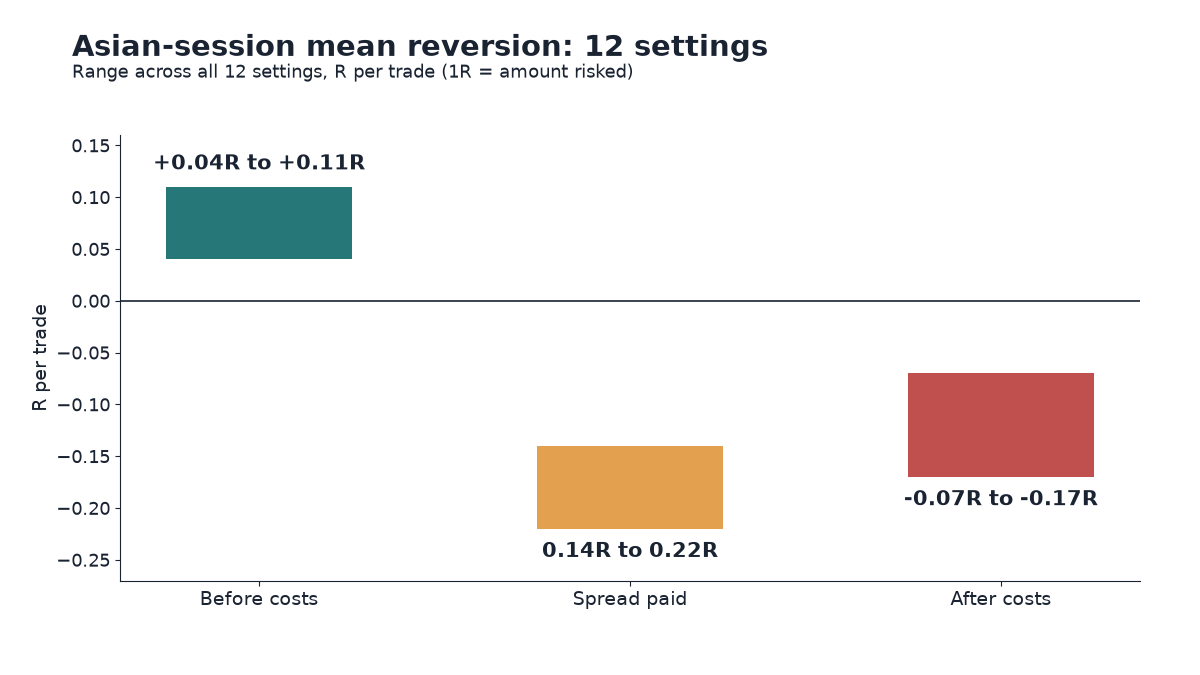
The arithmetic is simple. The edge was at most +0.11R per trade. The spread cost at least 0.14R per trade. When the cost of a trade is larger than its average gain, more trades only means more losses. Volume, the very thing forex scalping relies on, works against you.
Why more trades make it worse
At −0.07R per trade, the mildest loss we saw, every 100 trades cost 7R. At −0.17R, every 100 trades cost 17R. A forex scalping plan that takes many trades a week reaches those counts quickly. A negative average does not get better with practice or with more trades; it just adds up faster.
Spread cost per pair
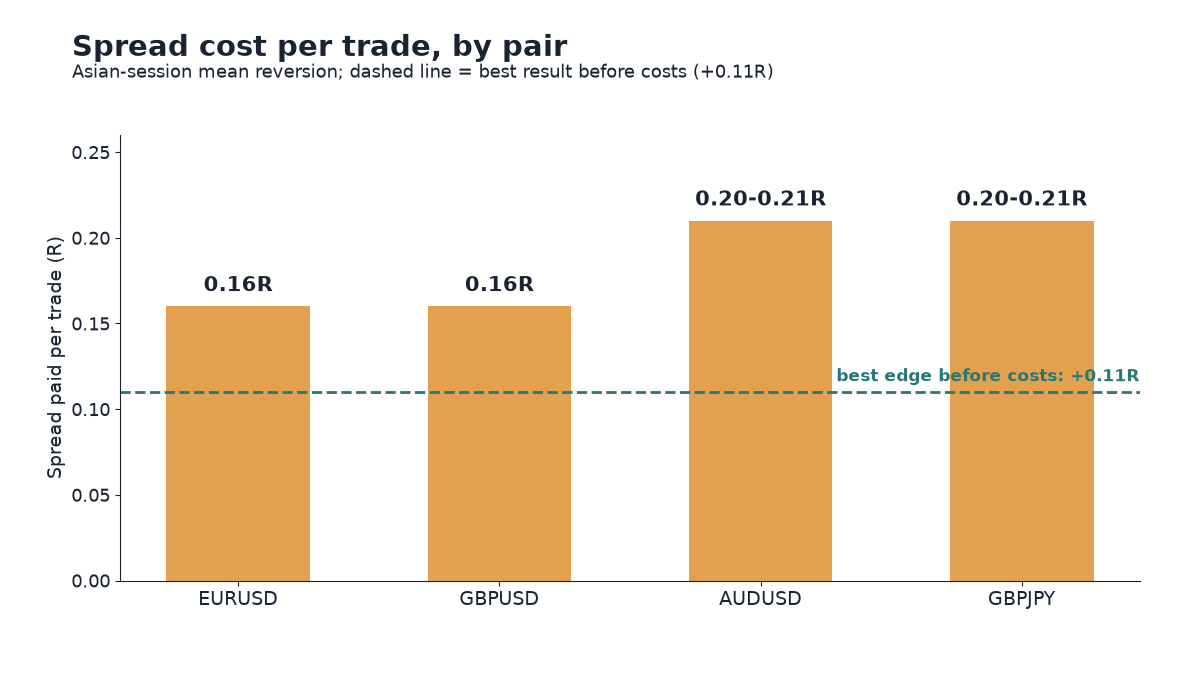
The cost was not the same on every pair. On EURUSD and GBPUSD the spread cost about 0.16R per trade. On AUDUSD and GBPJPY it cost about 0.20R to 0.21R per trade.
| Pair | Spread cost per trade (R) | Best edge before costs (R) |
|---|---|---|
| EURUSD | 0.16 | up to +0.11 (all pairs) |
| GBPUSD | 0.16 | up to +0.11 (all pairs) |
| AUDUSD | 0.20-0.21 | up to +0.11 (all pairs) |
| GBPJPY | 0.20-0.21 | up to +0.11 (all pairs) |
Even on the cheapest pairs, the spread was larger than the best edge we found before costs. On the other two pairs the gap was wider still.
Why forex scalping edges must beat the spread in R
Most traders think of the spread in pips. A 0.6 pip spread sounds tiny. But a strategy does not earn or lose pips in a vacuum. It earns or loses them relative to the risk it takes, and that is why we measure everything in R.
The spread in R is the spread divided by the stop distance. A forex scalping strategy uses small stops and small targets. So the same spread that is a rounding error on a swing trade becomes a big share of every scalp. The tighter the stop, the bigger the toll.
Put another way, every trade starts with a small loss: the spread. It has to win that back before it earns anything. For a swing trade with a wide stop, that starting loss is a tiny share of the risk. For a forex scalping trade with a tight stop, it can be most of the expected gain.
A simple illustration
Here is the arithmetic for a single trade, using spreads we measured on EURUSD. This is an illustration of the formula, not a description of our test’s stops.
| Stop distance | Spread cost at 0.6 pips (median) | Spread cost at 0.8 pips (90th percentile) |
|---|---|---|
| 3 pips | 0.20R | 0.27R |
| 5 pips | 0.12R | 0.16R |
| 10 pips | 0.06R | 0.08R |
| 20 pips | 0.03R | 0.04R |
| 50 pips | 0.012R | 0.016R |
Read the table from top to bottom and the problem is plain. With a 50-pip stop, the spread barely matters. With a 3 to 5 pip stop, it can be bigger than a typical forex scalping edge. A rule that wins +0.08R before costs needs its spread cost well below that just to break even.
The pass bar adds a safety margin
Our pass bar asks for more than breaking even. A rule must stay positive with 1.5 times the spread, because real spreads widen at the worst moments and fills are not always perfect. It must also reach a t-statistic of 2.0 on at least 100 trades in fresh data and beat 95% of 200 coin-flip runs.
For a forex scalping strategy, that 1.5 times test is brutal. If the spread already costs 0.16R, the stress test charges about 0.24R. An edge of +0.11R before costs has no chance. Our post on trading costs explains the full cost model.
Why a flat cost assumption misleads
Many backtests charge one fixed spread for every trade. That hides two things. First, spreads differ by pair, as our 0.16R versus 0.20R to 0.21R results show. Second, spreads vary from minute to minute, and a forex scalping rule trades whenever its signal fires, not when the spread is cheapest. That is why we charge the broker’s recorded spread at each fill.
What we measured at the broker
These are the median spreads we measured at OANDA since 2024, with the 90th percentile in brackets. The 90th percentile is the level the spread rises above only 10% of the time.
- EURUSD: 0.6 pips (0.8)
- GBPUSD: 0.9 pips (1.2)
- AUDUSD: 0.8 pips (1.0)
- Gold: $0.18 ($0.41)
- US100: 1.8 points
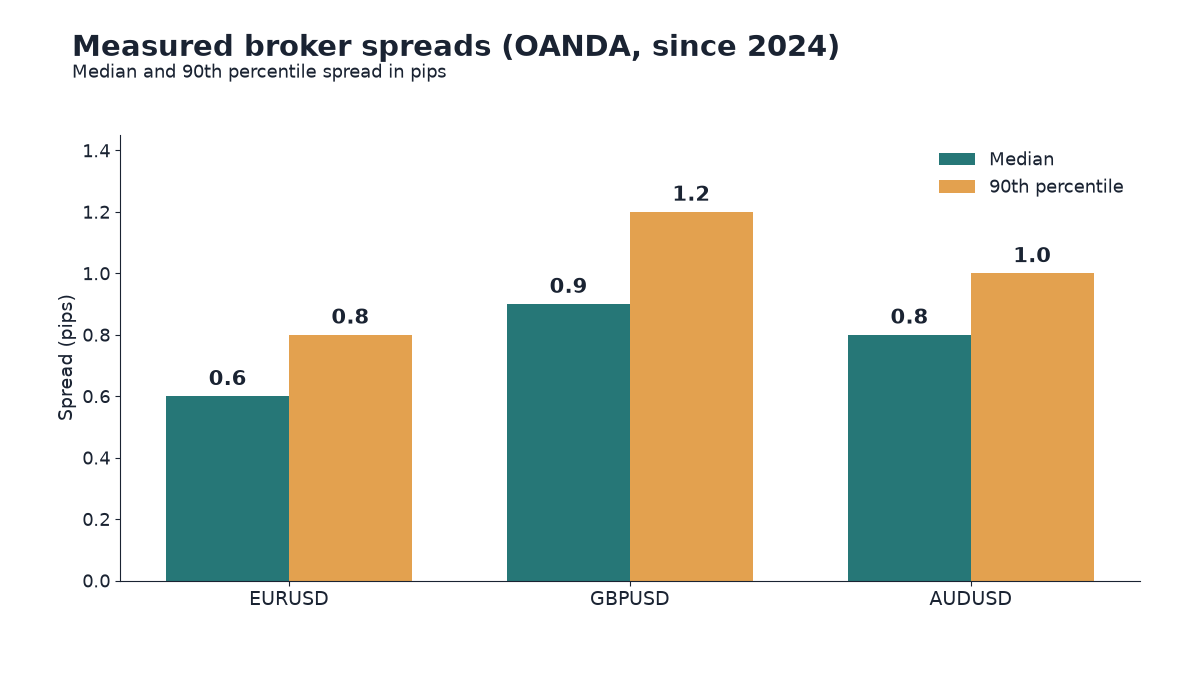
These are normal retail spreads, not unusually bad ones. That is the point. Forex scalping did not fail here because of a bad broker. It failed because ordinary spreads were larger than the edge in R.
When spreads run wide
The 90th percentile matters for forex scalping because a short-hold rule cannot wait for a cheap moment. On EURUSD it was 0.8 pips against a 0.6 pip median, about a third wider. On GBPUSD it was 1.2 against 0.9. On gold it was $0.41 against $0.18, more than double. A plan that only works at the median spread will meet wider spreads regularly.
We also learned to check the spread data itself. In a separate study, a broker export recorded zero spread for whole months of Bitcoin, about 12% of all BTC minutes. A backtest on that data would have looked far too good. We replaced each zero with that month’s median spread. If you backtest forex scalping, look at the spread column before you look at the equity curve.
Are raw-spread accounts the answer for forex scalping?
A common answer to this problem is a raw-spread or ECN-style account. These accounts quote a tighter spread and charge a commission per lot instead. It sounds like the obvious fix for forex scalping costs.
We checked. At large retail brokers, raw-spread accounts cost roughly the same all-in on EURUSD: about 0.6 to 0.8 pips once you include a commission of about $3 to $3.5 per lot per side. The cost moves from the spread to the commission, but the total barely changes.
For our short-hold rules to clear costs, the cost per trade needed to fall to about a third of what we measured. A raw-spread account does not get you there. The cost has the same order of size, and so does the problem.
What “a third” means for forex scalping
A third of 0.14R to 0.22R is roughly 0.05R to 0.07R per trade. Set that against the +0.04R to +0.11R edges before costs. Only at that much lower cost would the better settings have a margin left. That is the size of the change forex scalping needed in our test, and neither account type we looked at offered it.
Costs by holding period: spread for short, financing for long
Forex scalping is one end of a wider pattern we found across the edge search. Each holding period has its own main cost, and in our tests the edge rarely beat it.
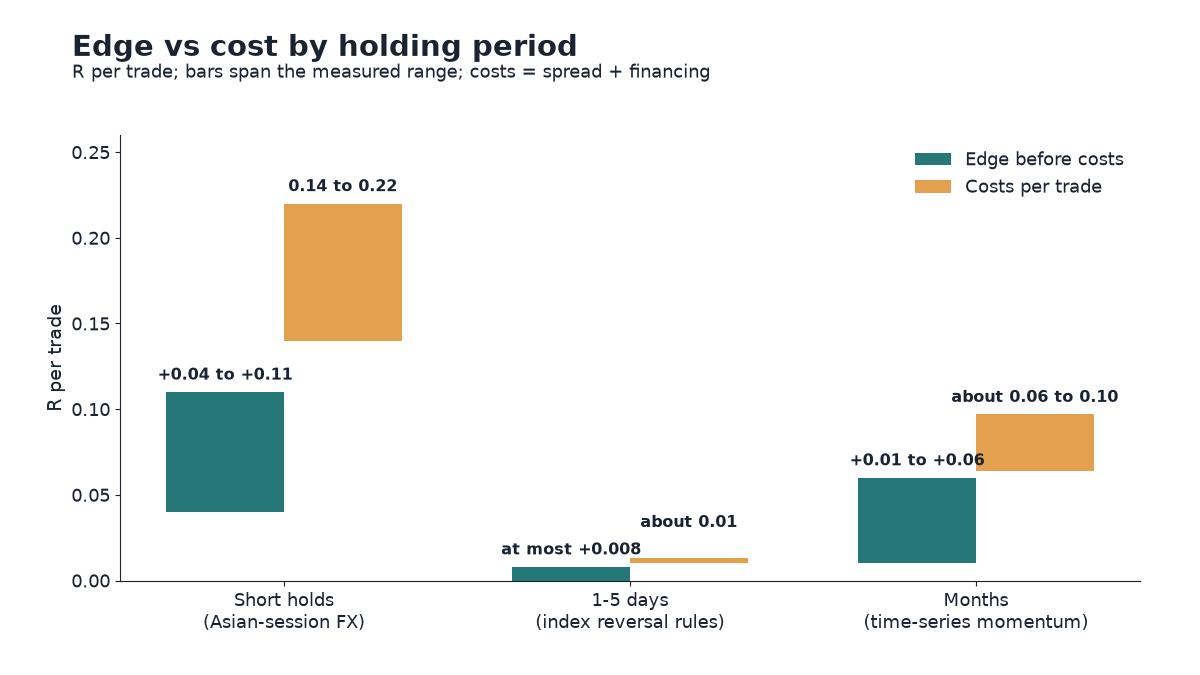
- Short holds lose to the spread. Asian-session FX mean reversion made +0.04R to +0.11R before costs and paid 0.14R to 0.22R in spread.
- Long holds lose to financing. Monthly time-series momentum made +0.01R to +0.06R per trade before financing. Financing cost 0.06R to 0.09R per trade, while spread cost only 0.004R to 0.007R.
- 1-5 day holds have small costs, but even smaller edges. On indices, costs were about 0.005R in spread plus 0.005R in financing, yet the reversal rules made at most about +0.008R per trade.
The overnight financing figures use stated assumptions: 3% a year for FX, 6% for metals, indices and oil, and 25% for crypto. You can read more in our post on swap fees.
So there is no free holding period. Forex scalping pays the spread on every trade. Swing and position trades pay financing for every night they stay open. A real edge has to be bigger than the main cost of the way it is traded.
Our other tests point the same way
The same lesson appeared when we independently tested a library of 39 registered strategies on EURUSD, GBPUSD, USDJPY and BTCUSD, on M15 and H1. In 15 of the 39 reports, one suggested fix was to “keep more of the edge the spread eats”. In 16, the advice was to drop M15, the faster timeframe.
Our SMC strategy backtest saw the same effect at a slower pace: its entries on H1 and M15 paid 0.02R to 0.25R per trade in spread. Those suggestions sound easy. We then tested the 25 most promising fixes, from session filters to H1-only versions, on markets they had never seen. With a corrected bar of t ≥ 3.11 for testing 25 ideas at once, none of the 25 was confirmed.
The wider research agrees. A study of Taiwan day traders from 1992 to 2006 found that less than 1% were predictably profitable after fees. In Brazil, of 1,551 people who day-traded mini-index futures for 300 or more days, 97% lost money.
In Australia, ASIC reported that in FY2024, 68% of retail CFD investors lost money, more than A$458 million in total, including A$73 million in fees. In the US, Barber and Odean found that the most active households from 1991 to 1996 earned 11.4% a year, against 17.9% for the market. Fast trading and costs go together, and forex scalping is fast trading. More numbers are in our post on retail traders statistics.
What would need to be true for forex scalping to work
I do not want to end on “it can never work”. The honest question is what would have to be true. From our numbers, a few conditions stand out:
- Costs cut to about a third. For our short-hold rules, total costs per trade needed to fall to about a third of what we measured. Ordinary retail and raw-spread accounts did not get there.
- A bigger edge in R. The edge per trade must clear the spread in R with room to spare, including the 1.5 times spread stress test.
- Wider stops relative to the spread. The smaller the spread is as a share of 1R, the less of the edge it takes, as the table above shows.
- Proof on fresh data. Any forex scalping rule should be confirmed on data it was never tuned on, and should beat random entries with the same stops and targets.
Questions to ask before you trust forex scalping results
- Does the backtest use the broker’s recorded spread at each fill, or one flat number?
- Are results shown in R, after costs, with the stop size stated?
- Does the rule still make money with 1.5 times the spread?
- How many versions were tried before the one being shown?
- Was it checked on later data it was never tuned on?
If a forex scalping system cannot answer these questions well, be careful. A curve that looks good before costs, or with a flat cost assumption, may be telling you about the edge but not about the toll. Our luck test post and our guide to out-of-sample testing show how to check the last point.
If you already run a forex scalping bot, an outside test can show what it does with your broker’s real costs. Our bot testing service runs your own code on years of broker data, splits the time into periods, runs luck tests and reports results by market and period.
Key takeaways
- Our forex scalping test, Asian-session mean reversion, was positive before costs in all 12 settings: +0.04R to +0.11R per trade.
- After the spread, all 12 settings lost: −0.07R to −0.17R per trade.
- The spread cost 0.14R to 0.22R per trade: about 0.16R on EURUSD and GBPUSD, 0.20R to 0.21R on AUDUSD and GBPJPY.
- Measure the spread in R, not pips: the tighter the stop, the larger the cost.
- Raw-spread accounts cost about the same all-in on EURUSD; short-hold rules needed costs cut to about a third.
- Every holding period has its main cost: spread for short holds, financing for long ones.
None of this makes forex scalping traders foolish. The edge we found was real before costs; it was simply smaller than the price of trading it. To see how we test every idea, read our method. If you want your own strategy checked against real costs, you can get your bot tested.